The Science
Copper peptides,
studied for the scalp.
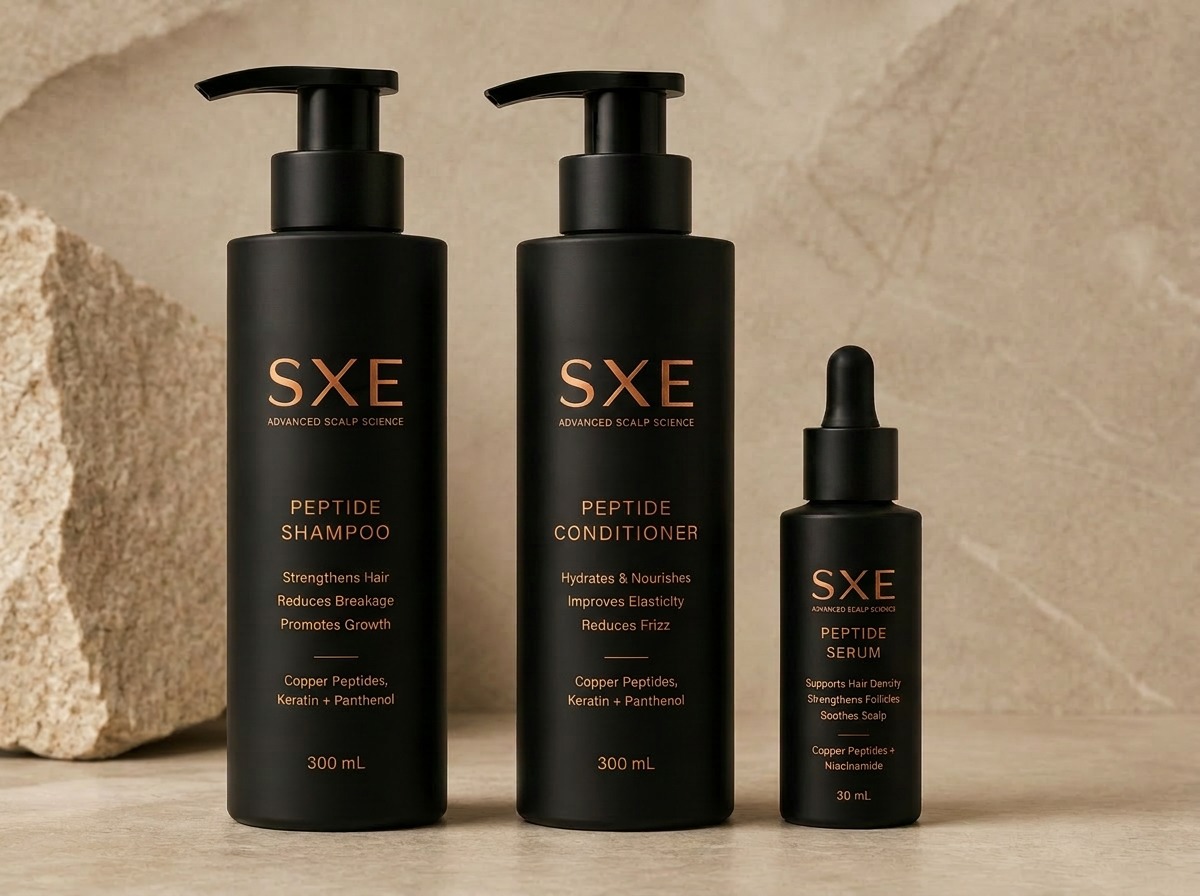
SXE is built around two copper-peptide complexes — GHK-Cu and AHK-Cu — chosen for their roles in supporting follicle health, hair density and the scalp barrier. Every product in the line uses them at meaningful concentrations, with formulas designed to be used daily.
01 — The premise
Why copper, why peptides.
Copper is a trace mineral the body already uses in the enzymes that build and remodel the tissue around the hair follicle — including lysyl oxidase, which cross-links the collagen and elastin scaffolding that anchors each follicle in the scalp. Without adequate copper available locally, that scaffolding is harder to maintain.
Peptides are short chains of amino acids. On their own, small peptides like GHK and AHK are recognised by the skin as signalling molecules. Bound to a copper ion, they become a stable delivery vehicle — the peptide carries the copper to where it is needed and releases it into the cellular environment around the follicle.
That combination — a targeted signalling peptide plus bioavailable copper — is why copper-peptide complexes have been studied for over four decades in wound healing, skin remodelling and, more recently, hair biology.
GHK-Cu
Copper tripeptide-1
A glycyl-L-histidyl-L-lysine peptide bound to copper. Studied for its role in signalling around the dermal papilla — the cluster of cells at the base of each follicle that regulates the hair growth cycle.
AHK-Cu
Density-support peptide
An alanine-histidine-lysine copper complex. Smaller and more skin-permeable than GHK-Cu, chosen to complement it and support the appearance of density and fullness over consistent use.
Niacinamide
Scalp comfort
Vitamin B3. Supports the scalp's lipid barrier, helps regulate sebum and calms visible redness from styling, heat and environmental stress.
02 — GHK-Cu, in detail
The signalling peptide.
Glycyl-L-histidyl-L-lysine : copper(II). First isolated from human plasma in 1973 by Dr Loren Pickart, who observed that older serum fractions behaved more like younger ones when GHK-Cu was reintroduced.
What GHK-Cu has been studied for around the follicle:
- Dermal papilla signalling. In vitro work suggests GHK-Cu supports the proliferation of dermal papilla cells, which govern the hair growth phase (anagen).
- Extracellular matrix remodelling. Studied for its role in supporting collagen and glycosaminoglycan turnover in the tissue that surrounds and supports each follicle.
- 5-alpha-reductase modulation. Early lab research has looked at GHK-Cu's interaction with the enzyme most associated with androgen-driven follicle miniaturisation.
- Antioxidant behaviour. The complex has been shown in cell studies to help quench reactive oxygen species — the same oxidative stress created by UV, pollution and heat styling.
SXE does not make medical claims. Individual results vary and copper peptides are not a replacement for prescription hair-loss treatment.
03 — AHK-Cu, in detail
The density peptide.
Alanine-histidine-lysine : copper(II). A smaller, later-generation copper peptide developed specifically with hair and scalp applications in mind.
Why we pair it with GHK-Cu:
- Smaller molecular size. AHK-Cu is more compact than GHK-Cu, which is thought to improve penetration through the outer layer of the scalp.
- Complementary signalling. Formulation research suggests AHK-Cu targets the appearance of hair fibre diameter and density, while GHK-Cu is more associated with the surrounding follicular environment.
- Better together. Stacking the two lets the formula stay effective at concentrations that are gentle enough for daily use, rather than pushing a single peptide to an irritating dose.
04 — Supporting actives
The rest of the formula matters.
Peptides only perform in the right environment. Every SXE formula is built around a supporting cast chosen to keep the scalp calm, clean and receptive.
Biotinoyl Tripeptide-1
A biotin-linked peptide often paired with copper peptides in hair formulas; studied for its role in supporting the follicle's anchoring proteins.
Caffeine
A well-tolerated topical stimulant used to support microcirculation at the scalp surface and to counter fatigue-related dullness.
Panthenol (Pro-Vitamin B5)
A humectant that binds moisture to the hair shaft, improving flexibility and reducing breakage between washes.
Niacinamide
Reinforces the scalp's lipid barrier, helps regulate sebum and reduces the appearance of redness from daily styling.
Hyaluronic acid
Holds water at the scalp surface without occluding the follicle — critical for keeping peptide chemistry stable and active.
Low-irritant surfactants
The Peptide Shampoo uses a sulphate-free cleansing system so the scalp barrier and colour treatments are preserved across daily washes.
05 — Formulation
Concentration, pH, delivery.
Copper peptides are fragile. They are sensitive to pH, to reducing agents (like vitamin C in the same formula), and to strong preservatives. Formulating with them is as much about what you leave out as what you put in.
pH window
4.5 – 6.0
The range where copper stays complexed to the peptide instead of dissociating and inactivating.
Delivery
Leave-on scalp serum
The serum is deposited directly at the scalp, not diluted through the mid-lengths, so peptides make contact with the follicle openings.
Free of
Sulphates, silicones, parabens
Removed so the peptide system stays stable and the scalp barrier stays intact between uses.
Packaging
Opaque, air-restricted
Copper peptides oxidise on exposure to light and air; bottles are chosen to protect the chemistry across a full 60-day use cycle.
06 — What to expect
The hair cycle sets the pace.
A single hair takes 2–6 years to complete its growth cycle. Any product working with follicle health is working over months, not weeks. Consistency is the active ingredient.
Week 1–2
Scalp feels calmer, less tight and less flaky between washes.
Week 3–6
Hair reads smoother and easier to style; less breakage on the brush.
Week 8–12
Users typically report the appearance of thicker, more even density.
Month 4+
Peak window: the follicles that entered anagen after you started are now visible.
07 — Safety
Well tolerated. Colour-safe.
Copper peptides at cosmetic concentrations have a long clinical safety record in topical use. The SXE formulas are non-irritating to the scalp barrier, safe on colour-treated and chemically straightened hair, and suitable for daily use by adults.
- Pregnancy & breastfeeding: we recommend checking with your GP before starting any topical peptide product.
- Vitamin C serums: do not layer a high-strength L-ascorbic acid product on the scalp at the same time — it can destabilise the copper complex. Alternate mornings and nights.
- Sensitive scalps: introduce nightly for the first week, then move to your preferred cadence.
Further reading
Hey Sexy
“Great hair doesn’t happen by chance. It starts with consistency.”
The Gift Box is built for a two-month refill cadence — the working life of a 300 mL bottle used daily.